LILO
Lilo, Georgia, c. 2000–1900 BC
Trialeti culture. Tanged bronze blade with a pronounced central rib (10% tin). Total length approximately 114 cm, excluding the pommel. Weight: 965 g. Replica of the original.

In Chapter I, it was suggested that the sword and new warrior ideologies emerged on the northern fringes of the Sumerian Uruk trading network at the end of the fourth millennium BC. There appears to have been a major disruption, accompanied by a southward movement of people: rich kurgan burials disappeared from the northern Caucasus, only to reappear farther south in Transcaucasia. Here, new kurgan traditions replaced the older Kura-Araxes culture, while Kura-Araxes-related ceramics spread southward across large parts of the Near East as the Uruk network disintegrated around 3000 BC.
In the millennium following Arslantepe, evidence for the continued use of swords is scarce. The most important evidence comes from the ‘Royal Tombs’ at Alaca Hüyük in central Anatolia, where at least three long swords were discovered. The longest, from burial A (A'26), has a long tang, sloping shoulders and a total length of 82.4 cm. All these swords have simple cross-sections—lenticular or flat/hexagonal—with neither ribs nor grooves. The cultural context of these burials, dated to around 2500 BC, remains poorly understood. They are often associated with the kurgan burial traditions of the Caucasus.
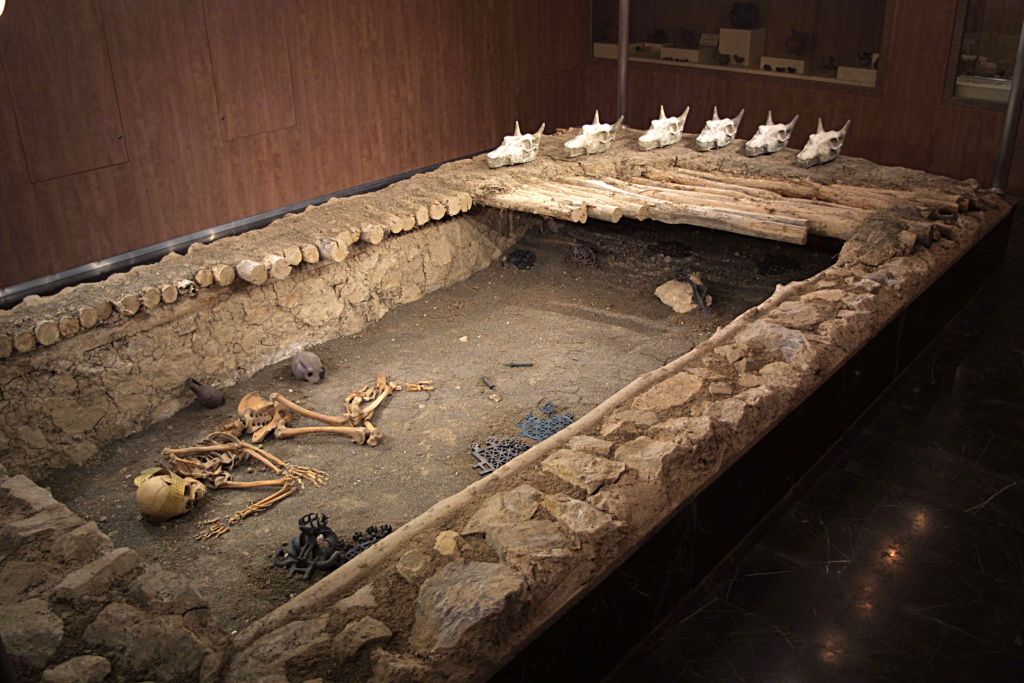
Museum display of a tomb from Alaca Huyuk.
Another important clue comes from the Caucasus. The Maikop culture, with its wealthy kurgan tombs, disappeared around 3000 BC, while similar burial traditions emerged farther south in Transcaucasia. The earliest horizon of kurgan burials there is known as Martkopi-Bedeni and has not yet yielded any swords. The subsequent Trialeti horizons, however, have produced swords. The earliest appears to be the sword from Saduga in Georgia, attributed to Trialeti phase I. Although only 49 cm long, it has a pronounced midrib and a significant tin content. This phase is dated to approximately 2500–2200 BC. The Saduga sword is important because it may mark the beginning of a continuous development towards the rapier. Samtavro burial 243, attributed to the transition between Trialeti phases I and II, contained a fully developed rapier, 99.3 cm long, with a high central rib. The Samtavro blade may therefore represent the earliest known fully developed rapier, dating to around 2000 BC, if not earlier. N. Sandars's major study of Aegean swords remains influential. She concluded that the Aegean rapier appeared fully developed at Mallia, Crete, at the end of MM II or the beginning of MM IIIB.
N. Sandars argued that the transition from dagger to sword occurred in the Levant, as illustrated by the early rapier from Byblos. She regarded the Byblos rapier, dated to approximately 1850–1800 BC, as the direct predecessor of the Aegean rapier.

The sword from Byblos. Length: 57 cm (Sandars 1961).
S. Shalev subsequently provided further evidence concerning this development. For about a century, the long sword from Beth-Dagon, near Jaffa in the Levant, was attributed to the Sea Peoples—specifically the Sherden—of the end of the Bronze Age, largely because of its resemblance to weapons depicted in Egyptian wall paintings. Closer examination, however, suggests that the Beth-Dagon sword is an elongated version of the daggers of the Levantine Middle Bronze Age I (type A). A characteristic feature of these daggers is the large number of rivets along a waisted hilt section. Metallurgical analysis also supports an earlier date: a blade from the period of the Sea Peoples would be expected to contain a substantial amount of tin, whereas the Beth-Dagon sword contains no tin but approximately 6% arsenic, with a higher arsenic content in its surface layer. The Beth-Dagon sword is therefore a stronger candidate for the earliest sword in the Levant, possibly dating to before 2000 BC. Importantly, it also shows how local hilt designs could be combined with foreign ideas about blade length.

The sword from Beth-Dagon. Length: 108cm.
It remains difficult to assign the Levant a central role in the development of the rapier and the sword, since so few examples are known compared with Transcaucasia and the Aegean. Moreover, straight swords clearly longer than daggers remained rare in this region throughout the rest of the Bronze Age. It is even possible to reverse the proposed direction of influence and consider whether the Byblos sword was made in the Aegean.
The Aegean rapier (the type A sword) is conventionally thought to have appeared first on Crete at the end of MM II. Developments in absolute chronology have shortened the estimated duration of MM II and MM III: MM II is dated to approximately 1875 (or 1850)–1750 (or 1700) BC, and MM III to approximately 1750 (or 1700)–1700 (or 1675) BC. This affects the dating of the swords found at the first palace at Mallia, although their attribution to a first-palace context has been challenged in favour of an MM III context (see Kilian-Dirlmeier 1993: 26 ff.). Consequently, the appearance of type A swords on Crete during MM II need not predate the type A swords from MH III at Mycenae (grave Iota, Grave Circle B) by many years (Dietz 1991: 261 ff.).
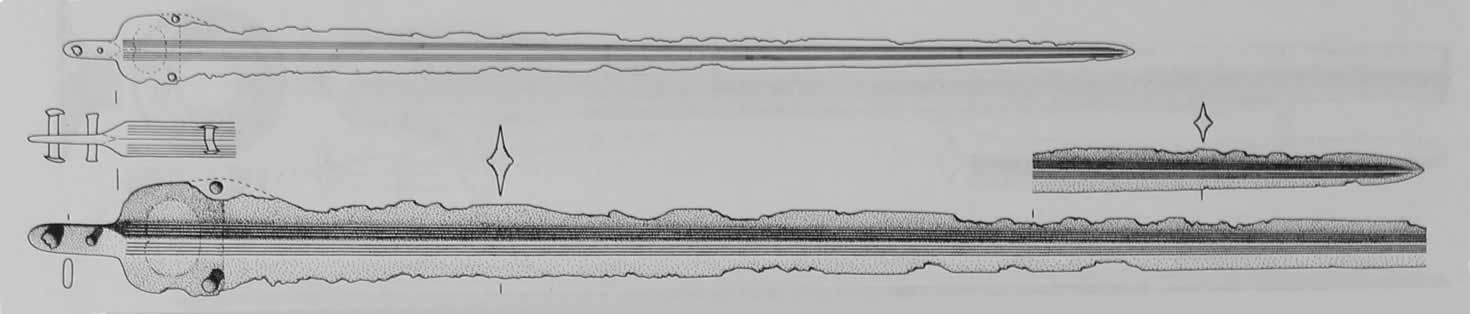
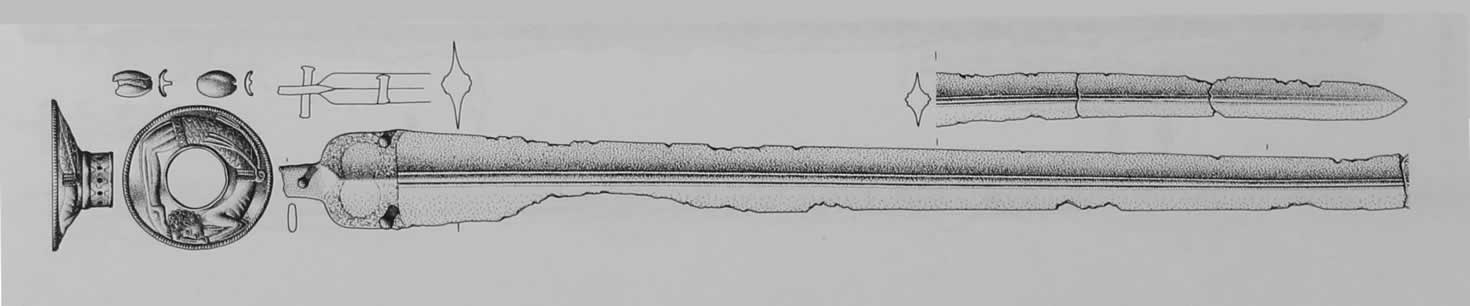
The two type A swords from the first palace of Mallia, Crete. Length: 81,2 and 74,1 cm (rearranged from Killian-Dirlmeier 1991).
The Mallia swords thus indicate that the type A rapier was fully developed before 1750 BC. From the outset, they display two features that would characterize Aegean sword design for centuries: (a) elaborate central ribs combining function and aesthetics through finely modelled ribs and grooves; and (b) complex, multipart hilts, often incorporating precious materials such as gold and ivory. These traditions continued through the Horned and Cruciform series until the appearance of the Naue II sword, with its simplified cross-section, around 1200 BC.
How should we understand the rapid spread of new metal forms from the Caucasus to the Aegean? Distinctive local hilt designs suggest that this was not simply a matter of trading finished weapons. Rather, it may reflect the spread of a new style of combat originating on the northern periphery. One of the least understood parts of this picture, at least among Western researchers, is the Trialeti culture of Transcaucasia. It is also worth noting that the Old Assyrian trading network, which extended across large parts of the Near East, has yielded neither finds nor images of long swords. For decades, objects from Trialeti burials were interpreted as imports from, or imitations of, Minoan and Mycenaean material and were consequently regarded as later and secondary. Yet the cauldron from kurgan XV, Trialeti phase III, has a virtually identical parallel in Shaft Grave IV at Mycenae. The end of the Trialeti sequence therefore overlaps with Late Helladic I on the Aegean mainland. Recognizing Trialeti as an early centre of metallurgical and weapon-related innovation fundamentally changes the broader picture. It also raises questions about the origins of the wealth deposited in the Mycenaean shaft graves. Burial practices, chariot equipment (including horse harnesses and whips), decorative motifs (such as rope-and-pulley patterns), socketed spears and rapiers all have potential antecedents farther east, from Trialeti in the south to Sintashta in the southern Ural foothills.
What seems clear is that movements of people—through trade, raiding and migration—along an east–west axis intensified sometime before 2000 BC. These movements probably followed routes across Anatolia and the Levant, as well as through the Bosporus and across the Black Sea. Although Near Eastern armies adopted the spoked-wheel chariot associated with peoples beyond their northern frontiers, they did not adopt the exceptionally long straight sword. Such swords instead became characteristic of high-status warriors and leaders on the northern periphery.
Scenes on a silver goblet from Karashamb, attributed to Trialeti phase II, may suggest that ordinary warriors typically used spears and daggers. The long rapier may therefore have been reserved for duels or individual combat among the elite. Mycenaean swords offer a particularly vivid indication of these ideals: a long, sharp blade decorated with running horses in low relief evokes swift movement and perhaps heroic traditions of sword combat. The ‘Running Horses’ rapier was reportedly found together with 90 other swords in Shaft Grave V at Mycenae.

Scenery from the Karashamb silver goblet, Trialeti culture c. 2000 B.C. (Digitally edited by this author). A story of battle, beheading of the loosers and listing of the spoils of war.
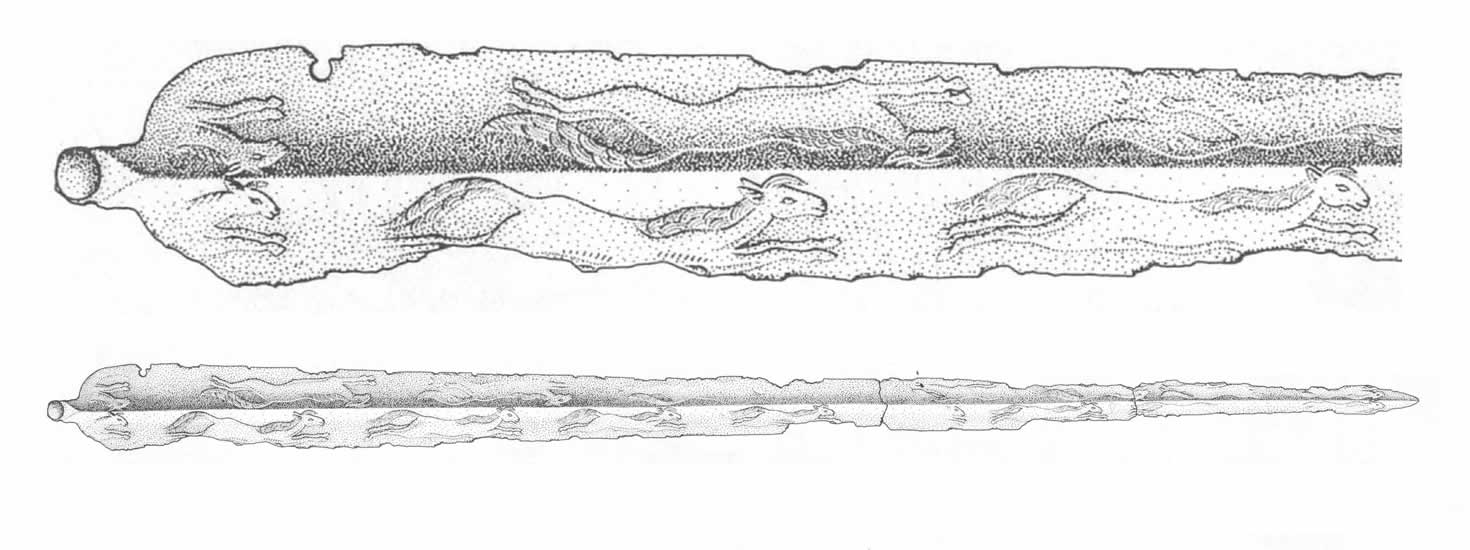
Type A sword with running horses, Mycenae Shaft-Grave V.
These models illustrate the period discussed in this chapter. For current prices and ordering details, see the Bronze Age Sword Collection.
Lilo, Georgia, c. 2000–1900 BC
Trialeti culture. Tanged bronze blade with a pronounced central rib (10% tin). Total length approximately 114 cm, excluding the pommel. Weight: 965 g. Replica of the original.
Beth-Dagon, Jaffa, Israel, c. 2000 BC
Bronze blade with a broad tang, 12 rivets and a pronounced central rib. Polished walnut hilt with an imitation ivory pommel. Total length approximately 108 cm. The image is a preliminary model; the finished sword may differ in details and finish.

Mallia, Crete, c. 1650 BC
Bronze blade with tang and 2+2 rivets (type A, variant 2). Total blade length approximately 83 cm. The image is a preliminary model; the finished sword may differ in details and finish.

Panagitsa, Chalcis, Greece, c. 1500–1350 BC
Greek horned sword, Kilian-Dirlmeier type 1a (Sandars type C I). Length: 88 cm. Weight: 700 g (bronze only).
.png)